
Differences Between an Inter Vivos Gift and a Private Loan
Differences Between an Inter Vivos Gift and a Private Loan
When a parent provides financial assistance to a child, or when one family member transfers money to another, is it an inter vivos gift or a private loan?
The distinction is fundamental because the tax implications are very different. A poorly documented transaction can lead to problems with the tax authorities.
What is an Inter Vivos Gift?
A gift is the gratuitous transfer of an asset or a sum of money without any obligation to repay it.
Characteristics:
✔ There is an intention to make a gift (the intention to give something freely).
✔ The recipient is not required to repay the money.
✔ It is subject to Inheritance and Gift Tax.
✔ A public deed is required in certain cases.
Example: Parents give their child €50,000 to purchase a property, with no obligation to repay the money.
What is a Private Loan?
A private loan involves a sum of money transferred with an obligation to repay it.
Characteristics:
✔ There is a commitment to repay the money.
✔ It can be interest-free or interest-bearing.
✔ It is not taxed as a gift.
✔ We recommend drawing up an agreement signed by both parties, specifying:
✔ The loan amount.
✔ The date the money is transferred.
✔ The repayment period.
✔ The method of repayment.
✔ Whether the loan is interest-free or interest-bearing.
Example: Parents lend their child €50,000 to purchase a flat, and the child will repay the amount over 10 years.
Private loans are subject to Transfer Tax (ITP), but are exempt from payment. This means that no tax is payable, but the transaction must still be declared using Form 600.
Key Differences
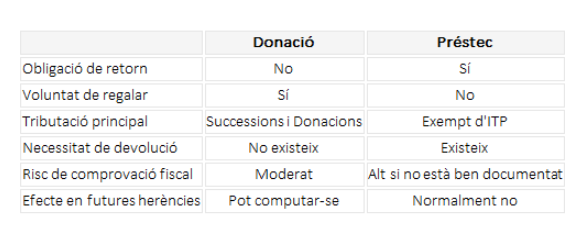
The Main Risk: Sham Transactions
The tax authorities may consider that an apparent loan is actually a disguised gift.
This is particularly likely when:
❌ There is no written agreement.
❌ No repayment deadlines are established.
❌ No repayments are made.
❌ The money is never repaid.
❌ The existence of a genuine loan cannot be demonstrated.
In these cases, the transaction could be taxed as a gift.

